


Imagine you’re on a busy Tuesday evening, navigating a complex DeFi swap on a new layer-2. The dApp asks you to sign a transaction, the gas estimate looks normal, and the UI shows the token amounts — but you still hesitate. Is the approval actually for a single swap, or a blanket allowance? Will the contract drain an unexpected token? This situation is routine for active DeFi users in the US: the risk is not just careless clicking but the structural problem called blind signing, where wallets hand over signatures without a precise, machine-checked account of what will change on-chain.
This article explains why transaction simulation — the feature at the heart of Rabby Wallet’s security model — matters mechanistically, where it helps and where it doesn’t, and how it compares to MetaMask, Trust Wallet, and Coinbase Wallet. You’ll come away with a sharper mental model of what simulation can detect, what it cannot, practical install-and-use trade-offs, and a short checklist to decide when Rabby’s approach measurably changes your operational risk.
What transaction simulation actually does (and how)
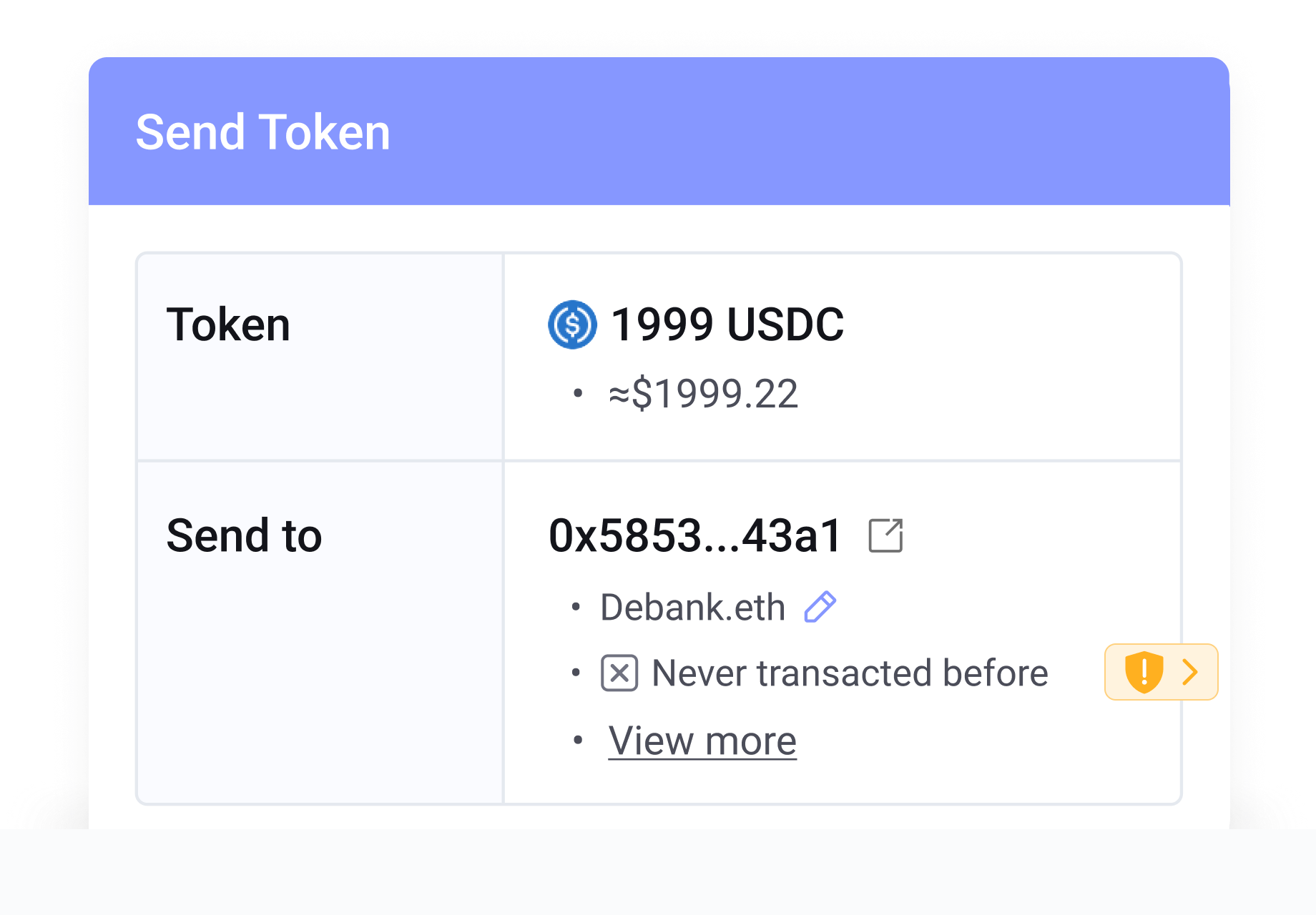
At the mechanism level, simulation runs the requested transaction against a local or remote simulator of the blockchain state before the wallet asks the user to sign. That means the wallet constructs the exact call data, executes it in a read-only EVM environment, and calculates post-execution balances, token transfers, and gas usage that the real chain would produce if the transaction were mined in the current block context.
Two practical consequences follow: first, you see explicit estimated token balance changes rather than trusting a dApp UI; second, the wallet can detect obvious red flags — non-existent recipient addresses, suspicious approval amounts (infinite allowance vs. single-use), interactions with contracts previously flagged for hacks, and wildly different fee estimates. This is the core of Rabby’s defense against blind signing: make the machine show you the outcome instead of letting a consent screen be an opaque trust exercise.
Where simulation helps — and its limits
Simulation is powerful but bounded. It reliably reports deterministic outcomes given the present on-chain state: token transfers, approval allowances, and whether a particular contract call would revert. That reduces surface area for many common scams and accidental approvals. For a DeFi power user juggling swaps, liquidity positions, and approvals across 90+ EVM chains, the hard fact that a wallet will show “exact estimated token balance changes and fee costs” before you sign materially lowers operational risk.
However, simulations cannot see the future. They run against a snapshot of state; they cannot predict a later block reorg, mempool front-running, or an off-chain oracle change that the contract will read at execution time, which may alter behavior. Nor do simulations prevent social-engineering attacks where the user is tricked into signing an otherwise valid transaction intentionally designed to move funds. In short: simulation reduces certain classes of technical risk but does not eliminate human and time-dependent vectors.
Installing Rabby and the practical trade-offs
Rabby is available as a Chromium browser extension (Chrome, Brave, Edge), mobile apps for iOS and Android, and desktop clients for Windows and macOS. For most DeFi users who rely on dApp interactions in a browser, installing the extension and importing an existing wallet with a seed phrase is straightforward. Rabby also offers a ‘Flip’ toggle to replace MetaMask as your default extension without losing access to the latter — useful during a staged migration or for A/B testing your workflows.
There are trade-offs to weigh. Unlike some mainstream wallets, Rabby does not include a built-in fiat on-ramp; if you want to buy ETH with a credit card inside the wallet you’ll need an external service. Rabby also lacks native in-wallet staking flows. Those limitations matter if you prioritize convenience for on-ramping or staking, but they are less relevant if your primary concern is secure, multi-chain DeFi activity paired with hardware-wallet-backed signing.
Security ergonomics: hardware wallets, approval revocation, and engine warnings
Rabby integrates extensively with hardware wallets — Ledger, Trezor, Keystone, CoolWallet, GridPlus, BitBox02 — enabling an offline private-key posture combined with pre-transaction simulation. Pairing simulation with a hardware signer changes the attacker calculus: an attacker would need to present a maliciously constructed transaction that also looks benign under simulation, or trick the user directly. Rabby’s pre-transaction risk scanner flags known hacked contracts and suspicious approvals and provides a native revocation tool to cancel prior allowances — a useful operational control for power users who repeatedly grant approvals to DEX aggregators or yield-farming contracts.
But remember the 2022 incident where a Rabby Swap-associated contract was exploited for ~ $190k: the team froze the contract and compensated users and then increased audits and security processes. This illustrates a boundary condition: wallet-level defenses reduce many user-side errors, but protocol-level vulnerabilities and smart-contract bugs remain an external risk that no wallet simulation can fully mitigate.
Comparing Rabby with MetaMask, Trust Wallet, and Coinbase Wallet
MetaMask is ubiquitous and minimal: it provides the core signing UI and network switching but historically has not shown deep pre-execution token flow simulation by default. Rabby differentiates itself by embedding simulation and automatic network switching, reducing manual context switching across networks. Trust Wallet and Coinbase Wallet prioritize mobile-first convenience and fiat on-ramps (in Coinbase’s case tightly integrated), so they trade some advanced pre-sign checks for ease of onboarding.
For a US-based professional trader or DeFi strategist, the trade-off map is clear: choose Rabby if you prioritize granular pre-sign visibility, hardware-wallet workflows, and approval controls; choose MetaMask if you require the broadest dApp compatibility and ecosystem tools; choose Coinbase Wallet if you value tightly-coupled fiat rails and custodial integrations. No single wallet is a universal solution — your choice depends on whether you value preventative checks or convenience more in your daily flow.
Decision-useful heuristics: when Rabby materially changes your risk profile
Here are practical heuristics to decide whether Rabby’s model is worth the switch:
– If you regularly grant approvals to new or bespoke smart contracts (aave forks, AMM forks, small-cap token sales), Rabby’s approval revocation and simulation reduce long-tail exposure.
– If you use hardware wallets and want the browser ergonomics without losing the hardware safety model, Rabby’s integrations make that workflow less error-prone.
– If your routine includes transacting across many EVM chains, Rabby’s automatic network switching and cross-chain gas top-up lower friction and the chance of sending tokens to the wrong network in error.
Conversely, if your setup relies on built-in fiat purchases, custodial syncing, or native staking dashboards, Rabby’s current limitations mean you may keep a second wallet for those conveniences.
What to watch next — conditional scenarios
Rabby is open-source under MIT, which invites third-party audits and community scrutiny; that is a positive signal about transparency. Future measures that would be meaningful to monitor include deeper mempool-aware simulation (to detect front-running possibilities), integrated fiat rails, and native staking flows. If Rabby adds mempool sensitivity or brokered fiat options without diluting the security model, the wallet could shift from a specialist security-oriented tool to a broader DeFi hub.
Regulatory signals also matter. In the US, increased scrutiny on custodial and fiat on-ramp services might favor non-custodial wallets that abstain from fiat integrations — but it could also reduce interchange and fiat channels that some users rely on. Watch policy movement and how Rabby balances compliance with non-custodial design.
FAQ
Does Rabby completely prevent phishing or social-engineering attacks?
No. Rabby reduces many technical attack surfaces by simulating exact token flows and flagging risky contracts, but social-engineering — convincing a user to intentionally approve a malicious transaction — remains a human problem. Use hardware wallets, maintain disciplined verification steps, and treat unfamiliar approval screens with skepticism.
How does Rabby’s simulation interact with hardware wallets?
Simulation runs before the signature step. When using a hardware device, Rabby shows the simulation outcome in the extension or desktop client, and only then sends the raw transaction for the device to sign. This preserves offline private key security while improving situational awareness about what the signature will authorize.
Can simulation stop zero-day smart contract exploits?
Not reliably. Simulation can reveal interactions that would move funds or expand approvals based on current state, but it cannot detect an unknown exploit that depends on later state changes or subtle contract logic that only appears under specific market conditions. It reduces risk, it does not eliminate it.
How do I install Rabby and keep it safe on my workstation?
Install the Chromium extension (Chrome/Brave/Edge) from official sources, import wallets via seed phrase only when necessary, and pair a hardware wallet for signing. Use separate browser profiles for high-risk dApp testing and keep your operating system and browser up to date. For more background on the product and links to official downloads consult the project’s pages such as rabby.
Summary takeaway: transaction simulation is not a silver bullet, but for active DeFi users it is a practical, mechanism-level defense that meaningfully reduces blind-signing risk and makes hardware-backed workflows safer. Rabby’s feature set — simulation, approval revocation, multi-chain gas top-up, and automatic network switching — reorients wallet ergonomics toward prevention rather than after-the-fact remediation. Use it to raise the floor of safety in your routine, and pair it with hardware signing, conservative approval habits, and a clear mental checklist for new contracts.